
The core shift is that coordination moves from agreement between people to alignment between flows.
In a traditional setup, coordination means negotiation: who gets access, who schedules production, who approves designs, who handles distribution. Each step requires some form of alignment between actors before anything can happen.
In this stack, coordination happens because the system is already structured to accept certain inputs and produce certain outputs. The designer does not ask a workshop for permission to run a job. They route the correct token into a machine interface, provide a valid instruction set, and the machine executes. The coordination is embedded in the interface itself.
Microfactory co-ops amplify this because they expose shared capacity as programmable entry points. Each machine, each material pool, each compute node is a surface that responds to well-defined inputs. A designer connects to that surface through a key and a token flow. There is no need to establish a persistent relationship with the operator of the machine. The relationship is defined at the moment of execution.
Open source hardware ensures that the physical layer participates in this same structure. A loom in one co-op and a loom in another can accept the same class of instruction because their firmware is transparent and modifiable. A designer can tune their instructions knowing how the machine will behave. That predictability removes the need for back-and-forth negotiation about execution details.
So the system organizes itself around three types of movement:
Encrypted data moving through private interaction channels.
Multiple designers can operate in the same co-op without forming a collective identity. Their flows intersect at machines and material pools, but their outputs remain distinct. Coordination happens because their tokens and instruction sets are compatible with the same interfaces, not because they have agreed on a shared structure.
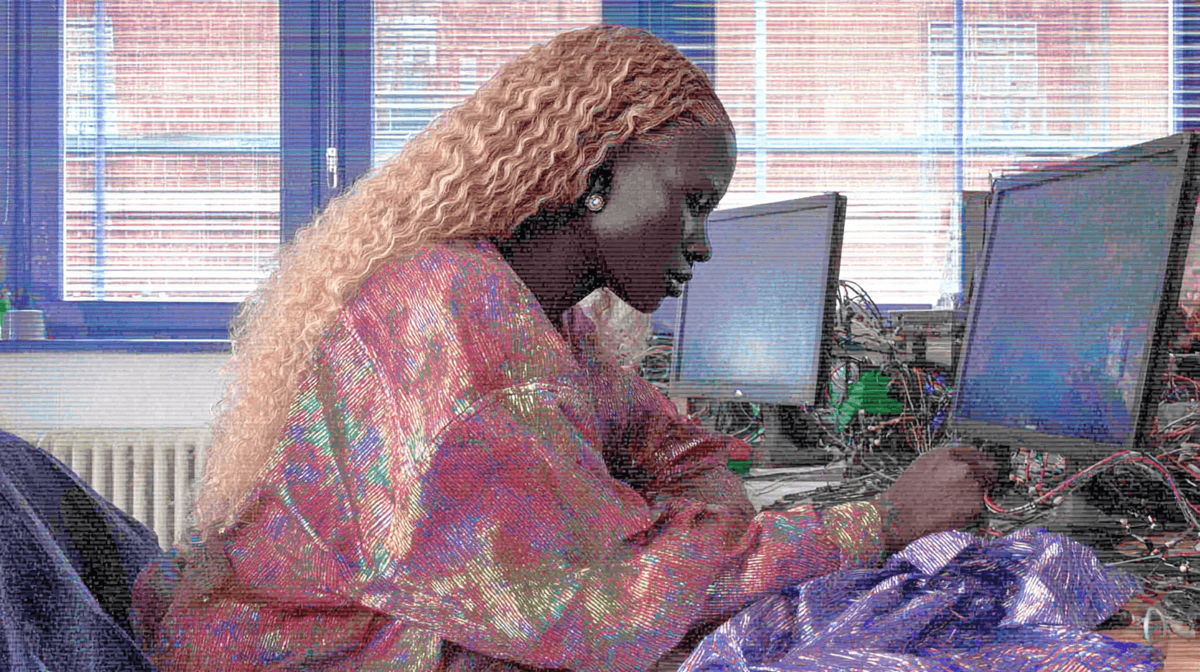
So coordination, in this sense, is not about managing relationships. It is about defining surfaces that respond to specific inputs and allowing those inputs to move freely across the system.
Tokens are what allow this to scale across multiple participants. They act as units that move through these entry points, carrying forward the sequence of actions. A fabrication token can be accepted by any machine that recognizes it. A material token can be routed into any pool that supports it. Because these units are standardized, they can pass across different co-ops, different workshops, different nodes without translation.
Confidential computing holds the private side of coordination in place. When a designer interacts with a buyer, or when a custom process requires sensitive input, that interaction stays bounded. It does not need to be shared with the co-op, the network, or other designers. The output of that interaction—an adjusted pattern, a finalized instruction set—can then enter the shared system cleanly. This keeps coordination focused on what needs to be shared, without expanding into everything.
Open design states moving through the commons.
Each type of movement has its own rules, and they do not collapse into each other.
This is what gives the system its flexibility. A designer can enter a co-op, run a set of jobs, publish outputs, and leave, while another designer continues using the same machines for entirely different work. The machines do not care who the designer is. They respond to valid inputs.
This is where decentralization becomes practical rather than ideological. It means that no single actor defines the pathways. The pathways exist as contracts and interfaces. Designers, machines, and agents connect to them directly. A designer can move from one co-op to another, from one set of machines to another, without rebuilding their process. Their tokens, their patterns, and their keys remain valid across spaces.
The commons layer feeds all of this with raw material. Patterns, garment states, and design logic move freely. Designers pull from it, modify it, and push back into it. Because this layer is open, designers do not need to negotiate access to ideas or starting points. The negotiation surface shrinks to the points where finite resources are involved—machine time, materials, and specific interactions.
Tokens moving through machine and workflow interfaces.
For the indie designer, this means coordination becomes a matter of routing rather than negotiating. They route patterns into the commons, tokens into machine interfaces, and encrypted data into bounded compute surfaces. Each route triggers the next step in the process.
Over time, more co-ops, more machines, and more designers join the network. Because the interfaces remain consistent—tokens, instruction sets, proofs—everything connects without requiring a central planner. The network grows by adding more surfaces that accept the same kinds of flows.
DIGITALAX.XYZ
COORDINATION
NPC STUDIO
AGENT COORDINATION



So coordination, in this sense, is not about managing relationships. It is about defining surfaces that respond to specific inputs and allowing those inputs to move freely across the system.